An architect rarely introduces themselves as anything beyond their title. Yet, somewhere between the first meeting and the final handover, a wardrobe begins to form.
The Listener
Present before the designer. Sitting across a table, decoding not just requirements but hesitations, ambitions, and the occasional contradiction that slips between sentences.
Briefs are rarely given; they are revealed.
The Negotiator
Not in dramatic exchanges, but in calculated pauses. Between budget and aspiration, urgency and patience, what is said and what is truly meant. It is less about winning and more about aligning without friction.
The Translator
Converting drawings into conversations,
ideas into reassurance,
and complexities into something approachable. Language here is not technical. It simply cannot even afford to be.
translation at times becomes our very bread and butter, between resolving the most complex constraint to even perhaps selling something in an avant-garde fashion!
The Mediator
Quietly holding space between differing opinions. Client and contractor, vision and feasibility, expectation and reality. The task is not resolution alone, but maintaining trust while arriving there.
The Optimist
On days when timelines stretch or decisions stall, this voice steadies the process. Not loudly, but consistently.
The Observer
Stepping back, reading the room. Understanding when to speak and when to allow silence to do its work.
None of these roles are formally assigned. They are assumed, adapted, and often discarded within the span of a single conversation.
They say an architect wears too many hats already, but too little in colours. We disagree.
Because beyond drawings and deliverables lies a spectrum of negotiations, adjustments, and reflections… sometimes even with oneself.
The drawings may define the space, but it is these unseen roles that shape the process.
Trends in the design industry are little instances of styles that turn up, turn heads, and either stay or fade away through interpretation.
At our studio, we don’t really chase a specific industry trend, as we believe that briefs come with unique constraints, requirements, and declarations that eventually frame a process sufficient enough for design goals.
We do, however, keep a watch on these smaller shifts in the industry, decoding what they truly signify about preferences, behaviours, and spatial aspirations.
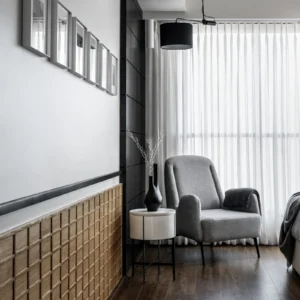
EXPRESSIVE SKIRTING + WAINSCOTING:
Introducing a little surprise of thickness and texture, a simple layer of cladded material often becomes a statement highlight to any bounding room.
At the studio, a large bold wall might be the canvas, but these elements define the necessary negative space before layers of visuals begin to weave a story.
What typically has been a protective technique against wear and tear also becomes our guiding tool for the eye and a storytelling device for the mind.
Roy Residence Courtesy: Greenhatcch Architects
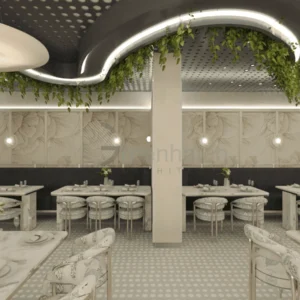
STATEMENT LIGHTING:
Lighting will always remain a conscious investment, powerful enough to completely alter moods.
It is always a performance, with control over placement, intensity, hue, and even the sculptural aspects of the fixture.
Because we have always been familiar with emitters being harmoniously attached to our surfaces and above the typical visual level.
Today, statement lighting reminds every visitor about its drama, performance, and the smaller dialogues it creates with the material of the space, even without illumination.
The Ivory Fork Courtesy: Greenhatcch Architects
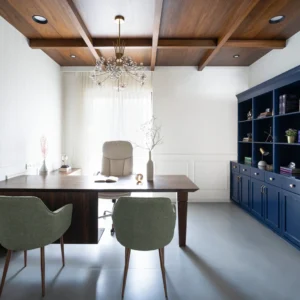
NEUTRAL AND MUTED PALETTE:
We endorse a finished look that is grounded in restraint. That is because we understand the intricacies that go into its arrival.
Perhaps there are certain realities in industry practice where design is not observed in such a detailed fashion. Yet, this is not a flaw of these tones, but rather a validation of the chosen and safe fallback they act as.
These are palettes that shed light and focus on other elements without appearing blank. They make room, visually and sensibly, to match the mood and temperament of the space meant to serve.
We prefer these in quieter spaces, signalling privacy, calm, and pause that is deeply personal. They ultimately allow small sightings of the room to take the lead while holding everything together.
Somehow, but surely, the neutral palette is no longer simply neutral in what it gives to the space.
Chemotest Office Courtesy: Greenhatcch Architects
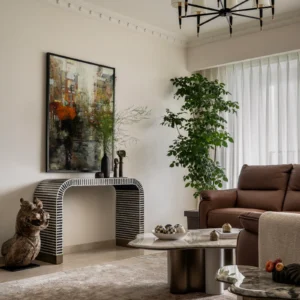
OBJECTS AS DECOR:
We enter spaces where interior design fundamentally integrates with all forms of lifestyle, routines, and behavioural traits.
Shared spaces have always been a home’s pride—a stage of display, status, and choreographed living.
Objects carry anecdotes, mood boards, and interactions, bringing a certain composition that architects or spatial designers alone would take too long to evoke.
They become living entities and rightful stakeholders of the rooms, while also, strangely, never filling the room.
The stories they carry must, of course, require a space to be heard. They are interruptions done organically, through elements that can be carried from home to home.
Brochures of history shared within the inhabitants.
The Woven house Courtesy: Greenhatcch Architects
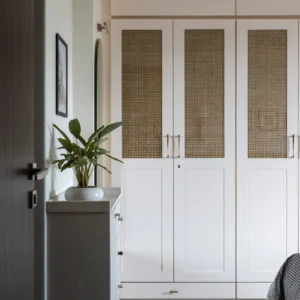
TEXTURED CABINETRY:
Our country thrives in craftsmanship. Handmade goods and objects carry skill, love, culture, and a strong element of care.
They are little nudges and nooks that add character to the space. The act of cleaning them attaches us closer to their making and place of origin.
We appreciate the stories they come with, and so does the space. Modern luxury is rooted in a form of consumerism that validates its creator and birthplace.
In a world where mass production of fittings and cabinetry has made what we overlay far more accessible, desires shift towards utility that does more than function.
Passaddahi House Courtesy: Greenhatcch Architects
OVERVIEW:
Some emerged from functional challenges, some derivatives of larger aesthetic and symbolic criteria.
A few of these have become techniques and tools we admit to having developed a personal liking for as well.
They end up reflecting the endless nature of the industry, as opposed to the filtering and carving of a niche that we, as architects, often pursue.
Today, we share a smaller glimpse into the executed experiments of the studio through the guise of five directions..
Each carrying its own weight, charm, and character.
Hospitality begins not with square footage, but rather intent. In a climate where spaces are heavily curated, measured, and deeply personal how do we make them responsive to temporary and diverse shifts of mood and temperament?
Making Room, even when there isn’t any:
In a setting where every corner already carries function and memory, making room for a guest is more about accommodation — spatially and emotionally.
However, much of the Indian context sustains in an environment of high-paced rigour and work. Among nuclear families and larger durations outside their personal four walls, even a curated home might make the idea of guests feel like an after-thought.
Yet for some, owing to many reasons, it remains a non-negotiable that often challenges the core assessment of such projects.
Living Compact Realities
The phrase “Atithi Devo Bhava” — the guest is equivalent to the divine — is not decorative rhetoric.
Our present urban reality might feel like a resistance to this generosity. Yet that has only allowed us to evolve our ways of thinking, better integrate layouts and ultimately make the best use of our spaces.
In this environment and economy, dedicating a permanently vacant room to occasional and differing visitors might feel indulgent and a tad bit excluding from the spatial narratives at play.
Hospitality in Multifunctionality:
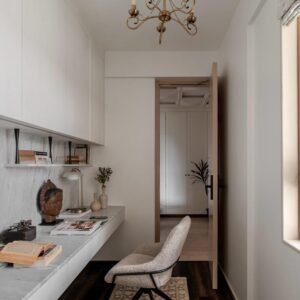
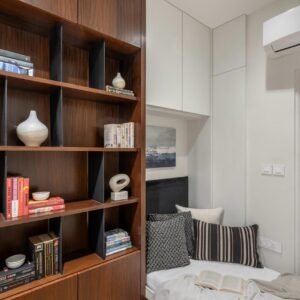
The contemporary guest room now begins to justify its existence in daily actions. No longer choosing to remain a static chamber, it becomes adaptive.
In the absence of guests, it transforms:
a study during exam seasons
a home office in hybrid work cycles
a prayer corner during festivals
a yoga retreat at dawn
Studio works Courtesy: Greenhatcch Studio
Traditional celebratory inspirations:
Historically, in Mughal residences, the Mehmaan Khana functioned in a similar way. (refer for detailed reading)
Despite acting as a defined guest quarter, it spatially integrated dedicated zones for entertaining and hosting visitors without blurring internal family life with public roles.
Designing for Absence as Much as Presence:
These rooms, much like the primary occupiers, become the transitional nodes of the house. Forever in a shifting state of programs, activities and moods, they are designed to perform in an allied fashion for the larger inhabitants of the house.
And at the time a guest arrives, reorient focus and present gracefully when occupied.
Studio works Courtesy: Greenhatcch Studio
After-thought:
Culturally, emotionally, architecturally, Indian homes are made to always keep room for even sudden and unannounced guests.
This gesture is sustained today by changing a singular destination to a fluid extension of everyday life.
This has allowed for a holistic and truthful integration of the vision from the spatial designers. At Greenhatcch, we’ve often faced these challenges and our clients have always realised the weight of simple yet practical solutions that enhance the quality of life for the house and people from beyond.