There is a subtle shift that accompanies larger residential projects.
As budgets expand, so do expectations. Pieces that were once perfectly acceptable begin to feel
strangely inadequate: not because they have changed, but because the project itself now seems to
demand something more exclusive.
A catalogue suddenly feels too ordinary. A handcrafted piece appears inherently
more valuable.
Somewhere along the way, customisation quietly becomes synonymous with luxury. It is an
understandable instinct. After all, if an entire home is being thoughtfully designed, shouldn’t every
object within it carry that same level of individuality?
But architecture has taught us that individuality is not measured by how many things are made
from scratch. It is measured by how intentionally each decision responds to the life it is preparing
for.
Luxury Doesn’t Begin With Customisation
There is an interesting misconception within contemporary homes that bespoke furniture
represents the final expression of thoughtful design. In reality, customisation is simply another
design tool; powerful when used with precision, unnecessary when used by default.
A luxury home does not become refined because nothing came from a catalogue.
Nor does a catalogue diminish refinement simply because it is accessible to others.
Architecture has always been less interested in originality for its own sake than in relevance. A
well-resolved object that perfectly fulfils its role often contributes more to a home than a custom
piece searching for justification.
Perhaps luxury is not the absence of standardisation. It is knowing when standardisation has already
solved the problem remarkably well.
Where Precision Earns Its Place
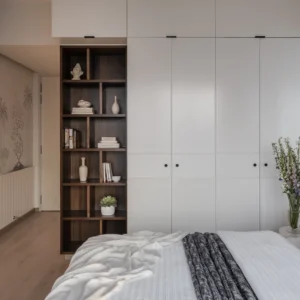
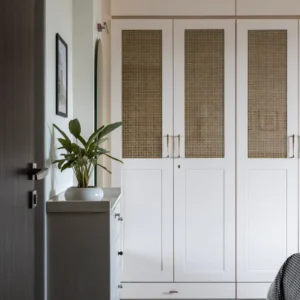
Custom furniture earns its place wherever architecture itself begins to negotiate complexity. These
decisions are rarely aesthetic first. Customisation here is less about creating something exclusive
than about removing compromise before it becomes visible.
Where Standardisation Excels
Other pieces benefit from remaining independent.
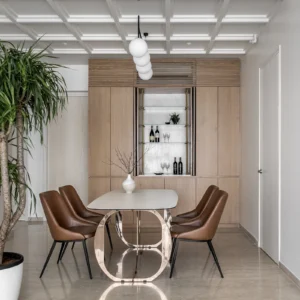
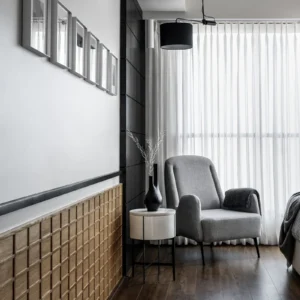
Dining chairs evolve with changing tastes. Coffee tables relocate with new layouts. Side tables,
lounge chairs, artwork and accessories naturally adapt as homes evolve.
Homes accumulate new routines, different technologies, expanding families and shifting
preferences. Furniture that can adapt often extends the relevance of a home far longer than
furniture designed to remain fixed forever.
Choosing something from a catalogue is therefore not necessarily the easier decision. Sometimes it
is the more generous one. It leaves room for the future. Designing permanence into every object
quietly removes flexibility from the people living with it.
As The Interior Dimension reminds us, interiors succeed not only through composition, but through
their ability to support changing patterns of occupation.
Furniture Has Its Own Life Cycle
One of the quieter responsibilities of design is recognising that not every layer of a home deserves
the same lifespan. Architecture may remain for decades. Joinery perhaps a little less. Loose furniture
evolves constantly.
Treating all three with the same expectation of permanence often creates
homes that become increasingly difficult to adapt.
Stewart Brand’s observations in How Buildings Learn are remarkably relevant here: buildings survive
because different components change at different speeds. Furniture is one of those changing layers,
and good design quietly anticipates that evolution rather than resisting it.
Designing Beyond Furniture
Perhaps this is what luxury homes increasingly prefer. Not an abundance of custom work, but
thoughtful calibration. Every decision asks whether permanence is truly necessary, or whether
flexibility will ultimately serve the home better. Good design rarely treats every object equally.
As How Buildings Learn observes, buildings evolve through layers that change at different speeds.
Furniture is one of the most adaptable of those layers, and recognising that allows homes to remain
relevant long after completion.
Luxury, then, is not making everything bespoke. It is knowing precisely what
deserves to be.
Nudges for further reading
How Buildings Learn – excellent support for the “life cycles” discussion.
The Interior Dimension – reinforces behaviour and interior adaptability.