-Architecture often prides itself on control. Every line drawn, every junction resolved, every corner composed with precision.
Modern design discourse frequently promises a complete spatial experience—an atmosphere so carefully curated that nothing appears accidental.
But life even at its highest pedestal cannot fully commit to such a robotic script. The space must begin to behave differently, turning into a layered and multifunctional story.
That is when elements that go beyond a drawing are consciously worked upon.
Why Nature in Common Spaces:
Common spaces are where architecture meets everyday life most directly.
Living rooms, courtyards, foyers, terraces—these are not spaces of momentary occupation but of repeated experience.
Their success lies in their ability to remain engaging over time. Instead of designing an experience once, nature allows the space to continue designing itself.
The act of taking care of our surroundings forms a mythical connection. Natural elements need care and give back in invisible ways that influence the mood of the entire day.
Starting With Nature, Not Adding It:
Nature is often treated as a finishing layer. But the deeper approach begins earlier.
Orientation, openings, thresholds, and courtyards become the starting diagrams, influencing the plan, the section, and the circulation. Not through lines or visuals, but rather as points that allow us to build relationships with smaller elements that make up the space.
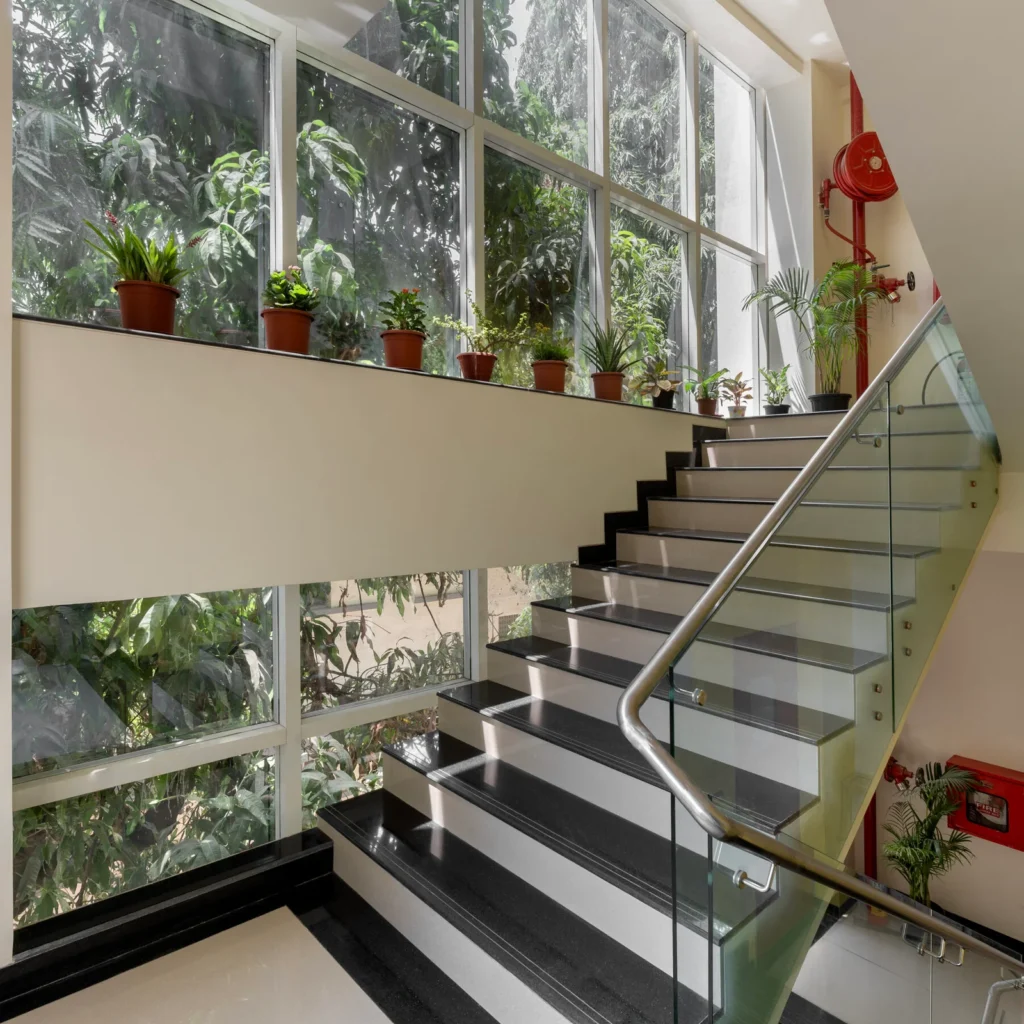
In such projects, architecture stops performing around nature and is grounded in pulling the exteriors indoors.
Designing Beyond “Style”
Minimalism, classical architecture, tropical modernism, or contemporary luxury, all of them can accommodate natural elements.
Nature however shines by introducing asymmetry, change, and evolution qualities rarely associated with rigid or ordered languages, pushing us from curating with materials to collaborating.
The result often brings out actions and interactions that feel less staged, more lived. Materials in this sense evoke different conversations over a long period of time, sharply changing the character of their space.
When Nature Becomes the Narrator
Plainly stated, the most memorable spaces often allow nature to lead the story rather than simply accompany it.
Oftentimes, aspects never spoken about or likely drawn in the final rendering become familiar corners or central conversational pointers for a community. They were realised in the design process, only in a largely understated magnitude.
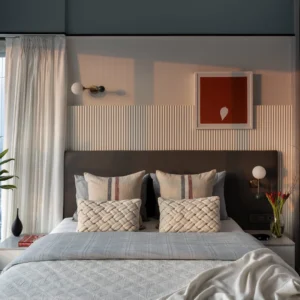
Yet they become the moments occupants remember most. Because our vision served as a platform for them, as it is meant to be.
In such spaces, architecture sets the stage but nature continues writing the script.
Overview — The Orchestra of Order and Chance
Architectural thinking traditionally values order, composition, and precision. These are the foundations of any well-designed space. Even when working with natural elements, these principles remain relevant.
But nature brings with it something architecture alone cannot fully control: randomness, change, and asymmetrical evolution.
The true orchestral beauty emerges when architecture accepts this uncertainty rather than resisting it. Design serves as the framework, while nature introduces variations: of experience, spatial presence and the microclimate.
Perhaps that is what nature embodies: not relying on perfection, but an environment that continues to adapt and evolve through participation long after the design is complete.