Glass today is rarely questioned. What appears as the obvious choice for façades pretty often extends to partitions, offices, even homes. But this rampant “default” is surprisingly relatively recent.
Today it signals many things, often in a not so transparent but somehow inherent manner, often without interrogation.
Somewhere along the way, we feel its adoption became less of a choice and more of an inheritance.
Origins
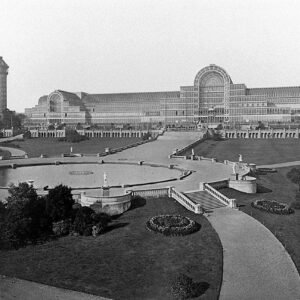
The architectural use of glass expanded dramatically with industrial advancements in the 19th century. The Crystal Palace (1851) demonstrated how glass could move beyond openings to become an entire structural skin.
References like Transparency: Literal and Phenomenal by Colin Rowe and Robert Slutzky, and essays on ArchDaily and RIBA Journal, further trace how glass evolved from innovation to ideology, eventually embedding itself as a global architectural language.
In India, the proliferation of glass façades accelerated alongside liberalisation and globalisation in the 1990s and early 2000s. Corporate architecture began aligning with international aesthetics, supported by a rapidly expanding ecosystem of façade engineering, glazing systems, and material supply chains.
Through Symbolism and Meaning
Glass has been given a voice to represent more than enclosure.
Earliest renditions began to signal openness, progress, and institutional transparency. Buildings like Seagram Building framed corporate clarity, while the Apple Park uses glass to dissolve boundaries between inside and outside.
Yet psychologically, constant visibility alters how we occupy space. Transparency, when continuous, can feel less like openness and more like exposure, quietly reshaping behaviour, comfort, and spatial hierarchy.
The Contradiction
Despite its visual lightness, glass often performs poorly in many climates. High heat gain, glare, and dependence on mechanical cooling create long-term inefficiencies.

Courtesy: @Arefin Shamsul
In the Indian context, fully glazed façades frequently contradict climate-responsive design principles, especially in regions with intense sunlight, where comfort is achieved not through exposure, but through calibrated protection.
What’s Being Ignored
The persistence of glass is far from accidental. It is supported by industry, familiarity, and aspiration.
Most importantly, decades of efforts fueled into refining accessibility and procurement.
This reliance has grown strong enough to sideline more nuanced, climate-responsive approaches.
There is a certain inertia at play. Questioning glass means rethinking systems, and that shift, while necessary, is rarely immediate or convenient.
Larger Dilemma:
Rather than focusing solely on replacing materials, the opportunity lies in rethinking spatial strategies.
While the glass industry operates at a massive, established scale, meaningful change does not always require dramatic material shifts. It begins with design intent.

Courtesy: @Pixabay
If commercial spaces can move beyond flat visual statements and engage with section, layering, and climate, the expression of architecture becomes richer, more responsive, and less dependent on a single material narrative.
Overview:
Modern need not translate to uniform, reflective skins. True modern thinking is responsive, contextual, and efficient. The widespread use of glass today suggests a drift toward visual sameness rather than innovation.
Perhaps the more relevant question is not whether glass works, but whether we are still actively choosing it. Or have these decisions become inherited defaults:
Repeated across projects without pause, simply because they have long been accepted as the norm?