“The idea of an informed client has shifted significantly in a short span of time.”
For better or worse, previous notions of what defines an informed client reflect only a fraction of what they bring today alongside a brief and a budget.
Faced with these lived realities, architects stand at a threshold of introspection: If this step up has transpired, how does the designer now do it justice?
Today’s design landscape:
We live in a paradoxical simulation of the design business.
For every aspirant in the world with a certain sensibility and thought for their dream project/space, there are dozens more of studios and architectural firms ready for a discourse.
We live in a time where practice at all scales has the freedom and potential to fall on a larger audience with a significant visual showcase of what they stand for, building towards what we call accessibility of thought and intent.
Marking an entrance:
The first impression now rarely comes from the first meeting.
Capturing a client’s identity in one go is a dated concept as of today. It is a complex and layered arrangement, often understated due to the invisible ways in which biases around us mould our thinking.
-Slowly but surely, they arrive with Pinterest boards, material samples, travel references, and a sense of what feels right before we ever begin a design dialogue.
Some of these impressions can distort the perceived role of the designer. This element of clarity rooted in authorship might make some designers begin to believe that consultation is only a means to an end for the vision at hand.
But designers need not feel clouded or overwhelmed by such simple realities: the age of an informed user will only expand here onwards.
Reading between the words:
This accessibility of information, owing to the democratization of imagery and ideas, does not automatically translate into clarity. It often raises the bar for what meaningful collaboration looks like.
Yet the ease of access is only the beginning, not the destination. The internet guarantees a visual representation or language that helps everyone express an intent, enabling a step 0.
Courtesy: Greenhatcch Studio
But the kind of authorship people command today comes from stories, places, memories, and preferences of the subconscious mind, something we as designers must relearn to trace and uncover.
What next:
This evolving client archetype demands depth of research, not repetition of clichés. Above all, they remind us why hands-on conversations matter.
Because while the world makes visuals accessible to everyone, it does not make shared meaning accessible without dialogue.

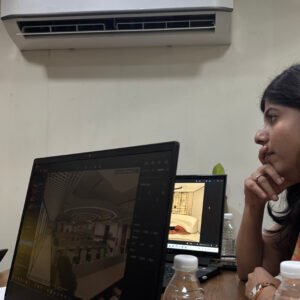
Courtesy: Greenhatcch Studio
By making visuals, flashy references and widespread information the start, the discussion is allowed to grow richer, turning subsequent solutions into grounded proposals that reward the process and relationship cultivated, perhaps as much as the end result.
Overview:
Greenhatcch has developed an archive of experiences pertaining to clients that push the brief and us in the most pressing but rewarding directions.
A practice that values the voice, its vulnerability and the blind trust it carries, it is the regard of many of these informed individuals that has expanded our scope, our lens of thought and a larger push for us to reach agreeable solutions.
An informed client in 2026 knows what they like, but that presses us to increasingly ask why they like it.
There lies the next step for our evolution.