-How spaces quietly influence thought, focus, and creative rhythm
Our mind is capable of visualising, sensing and evoking possibilities from mere words and thoughts. This makes the act of Reading and writing feel incredibly grounded as activities.
Sometimes external stimulus helps or deteriorates in this very process. Essentially, when we are engaged in a thoughtful action, our brain conducts an extensive mental exercise.
One absorbs while the other distills: Fragments of thoughts, ideas and inferences. In the chaos of this internal discourse, how exactly does our inhabiting spaces play a role?
The Role of the Space We Inhabit:
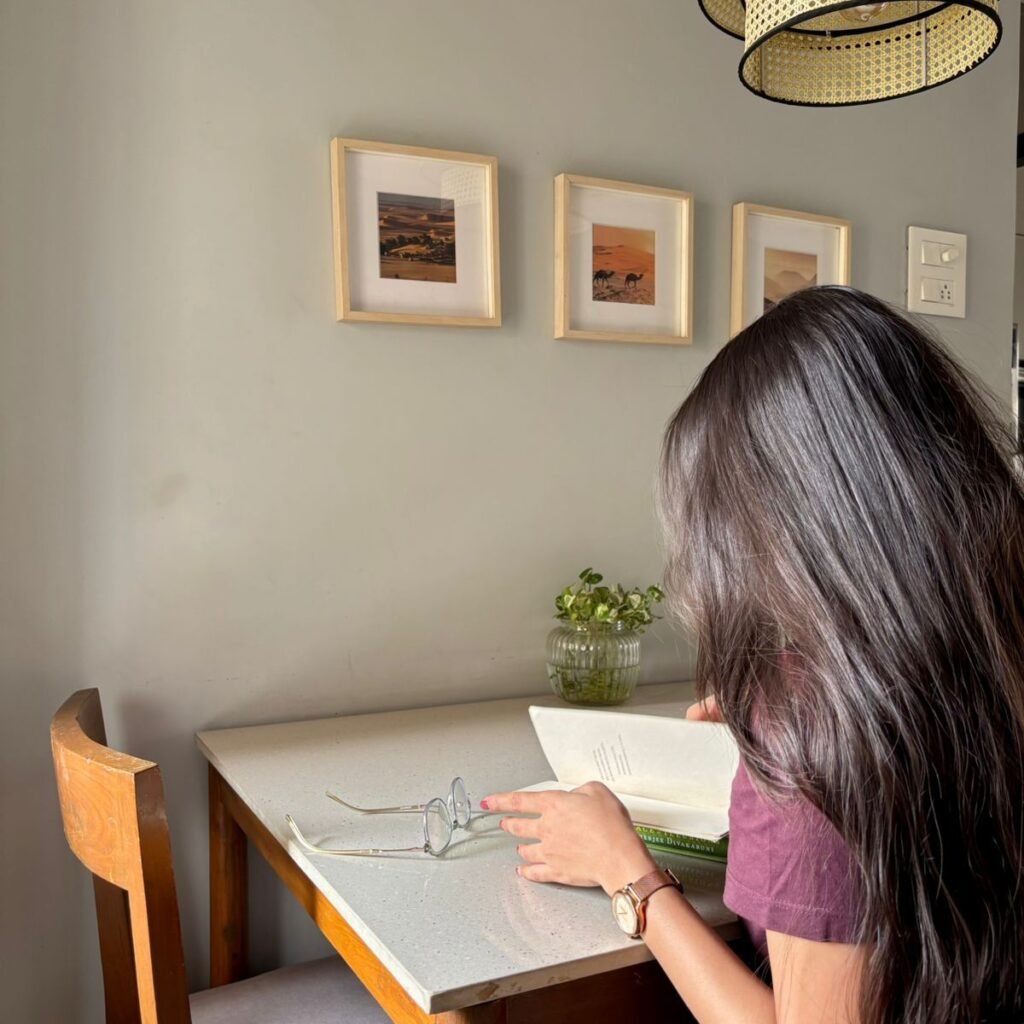
A desk and a chair is perhaps the most visual metric for this exercise. Yet there are the senses, light and sound, be it rhythmic or as noise of uninterrupted frequency.
Too much of it can be obstructing and yet too little of it can make us feel bleak.
But when everything does line up, our preferences balance productivity with ease. The perfect conditions do not demand acknowledgement; instead serve as the invisible component of good design.
When Space Becomes a Silent Collaborator:
In a space that best fits any user, the act of writing becomes transformative. It no longer hinges on the individual’s ability, rather good design inherently encourages participation.
The bridge between ‘Creative work’ and ‘Creative freedom’ blurs over here. Realistically, neither need any metric or scale of judgement as long as they help the participant feel accomplished.
The room here is a silent collaborator, one that doesn’t ask for credit because its role was to serve as a medium that channels productivity.
After-thought:
The space we feel best in is much more than a backdrop.. and it’s design must first understand how thoughts truly cultivate.