The first thirty seconds inside a space never feel long, yet the lingering impression they carry cautiously influences the tone and nature of the visit that follows.
India has witnessed a vivid growth spurt in business over the last decade. Emerging founders, entrepreneurial opportunities, coworking spaces, and even temporary commercial hubs have found ways to develop.
Be it a suspicious-looking building or just another glass-box skyscraper, we rarely gauge the character of an office solely through its façade.
Beyond referrals, websites, and conversations with affiliated parties, something about the space drew us to its physical address. That first impression served its purpose: inviting fresh eyes and curious movement.
Sufficient for entry. But now the space must step up. What, then, becomes the new logo for a commercial venture?
Welcome aboard:
Experience is everything. Even within a limited span of time, it holds the power to shape opinions through the moods and feelings we perceive.
The reception area is where everything condenses into a singular moment. Intent, pause, etiquette, and inquiry all converge here.
It becomes a display of the host to the guest, signalling preparedness: not just of the room, but of the people who inhabit the larger environment.
These individuals have curated this threshold for varied encounters, all leading to dialogue.
Upon arrival, the goal is to forget what could not be controlled: dense contexts, repetitive commercial clusters, or unremarkable entries. Whether these worked or not, the reception should not let them define the experience.
Reading between the lines:
This threshold is far from passive. Though often treated as a pause point, the way one enters, waits, or is guided forward begins to shape interaction. It subtly informs body language and expectation.
Hierarchy is inherent to office environments. At entry, the guest and host form the primary dynamic, while objects occupy a secondary role.
Hospitality here exists even without conversation. Proportion, material, light, and spatial language have already been spoken from the first moment.
No interaction is in itself an interaction when every impression is calculative.
How much a reception unveils about the larger office, how much it chooses to mask to create a self-contained room, what are the bounding lines in this domain are valuable questions that make this a miniature design esquisse during an interior proposal.
Are we doing just enough?
Accessibility of all forms becomes explosive. The more your space feels accommodating, the faster time naturally dissolves without inducing any negative bias.
The next time you find yourself at a reception: behind the desk or in front of it, observe how naturally the space operates. It often reflects a glimpse of what a first-time visitor might feel.
The next time you are positioned at the reception, behind the desk or right in front of it, a simple check of how natural the space feels can gauge a lot about what a stranger would perhaps feel coming there.
But comfort must be temporal here.
A seated participant is an active call to action: not just to the reception spokesperson but the entire layout. Unknown Intent coming from anyone is uncertain but can never be gambled with from an economic standpoint.
Chemotest Office:
Testing labs typically come with a clean, medically sound design language. Emotionally, visitors often come from a place of inquiry, consultation and associated tasks.
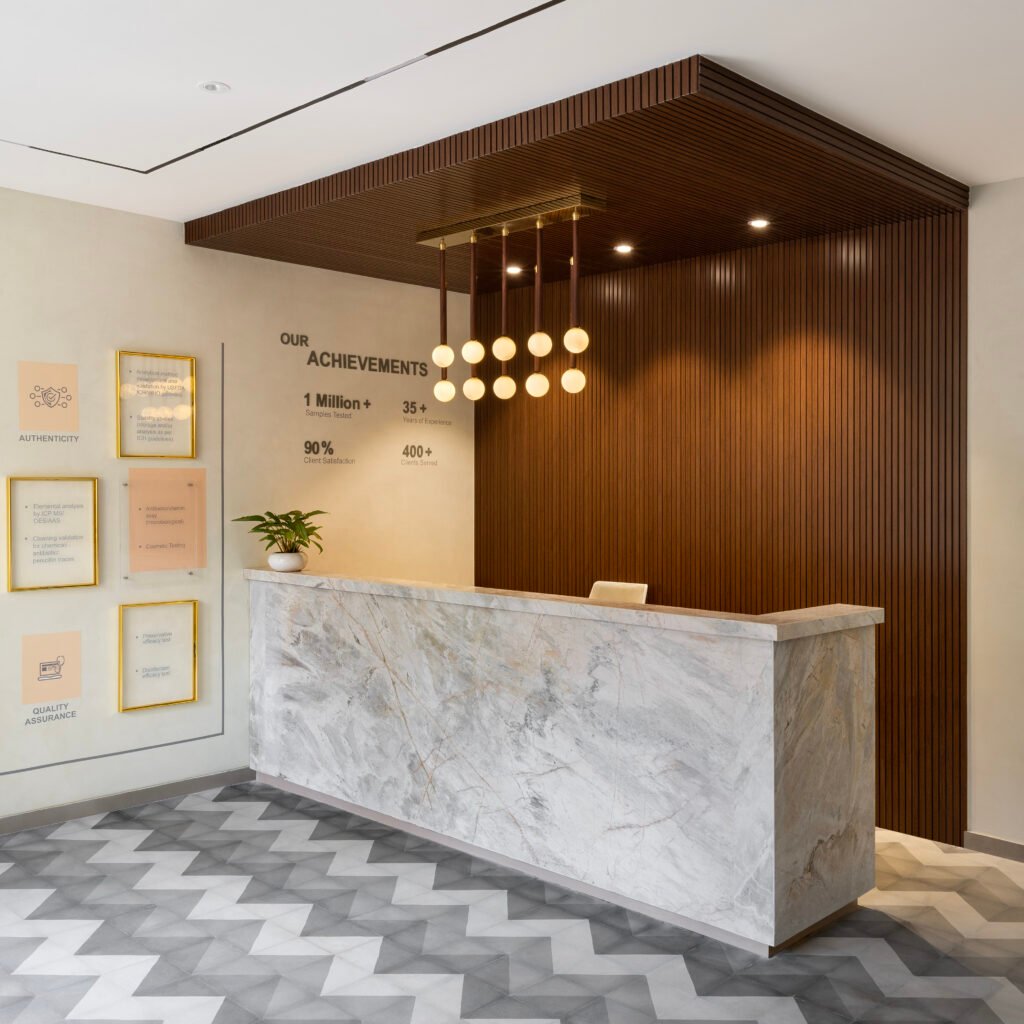
At Greenhatcch Architects, the entry envisioned a bright and warm welcome within the compact space. Material finishes were at the forefront of the structural elements as well as objects and furniture existing in this area.
The side wall reinforces confidence and trust through statistics and testimonials but before that, the space is already offering a much more lively welcome and halt by the wide reception.
Wooden finishes gradually unfold to the working areas creating a smoother transition along with fluid tile work ensuring a pause that doesn’t turn to a lingering stop
Design must respect time without eliminating pause.
Spaces should engage without distracting from purpose.
Accommodation must offer respect over indulgence.
Transitions should feel fluid, not abrupt.
Even in departure, the space leaves behind a subtle residue of comfort. A reminder that in environments defined by precision, design can still make room for reassurance.
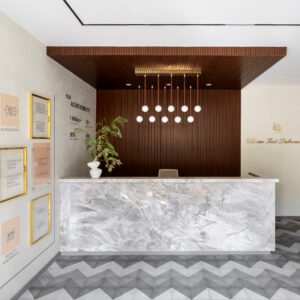
Entry + Reception
Courtesy: Greenhatcch Architects
Overview:
In these brief moments, design reveals its sharpest understanding—not of theory, but of people, behaviour, and intent.
Spaces that rely on excess often mask sterile environments that fail to balance hospitality with momentum.
The first thirty seconds at a reception can shift from fleeting to lasting only when storytelling resonates on both ends—drawing from the values a company upholds and translating them into spatial strategies with clarity and honesty.